
Spring Sale! Upto 50% Off!

Overheating in your NYC studio? Waking up with frizzy hair and pillow creases? Let’s cut through the confusion—and show you exactly which layer solves your real urban sleep...
If you are comparing quilt vs comforter, these resources can help you check product details and next steps.
If you are comparing quilt vs comforter, these Promeed resources can help with product details and next steps: HerbalRX™ Sleep Aid Quilt; Comforter; Flat Sheet vs Fitted Sheet: Why You Need Both for Perfect S….
Mulberry silk is valued for its long, smooth protein fibers, which create a soft surface that reduces rough friction against sensitive skin during sleep.
Look at fabric smoothness, momme weight, breathability, and care routine together so the material feels gentle night after night without becoming difficult to maintain.
When you walk into your bedroom after a long day navigating subway platforms, back-to-back Zooms, and the low hum of city life—your sanctuary shouldn’t ask questions. It should answer them. So when you see "quilt vs comforter" pop up in your search bar (or worse—on three different bedding sites with contradictory advice), it’s not indecision slowing you down. It’s decision fatigue. And in New York, London, or Singapore apartments where square footage is premium and air conditioning runs on hope, choosing between a quilt and a comforter isn’t just about warmth—it’s about breathability, skin integrity, seasonal agility, and whether your bedding quietly supports—or silently sabotages—your recovery.
This is the Urban Oasis Guide: a calm, evidence-based breakdown designed for the 25–45 professional. We’ll show you how Promeed’s 23-momme Skin-like™ Silicone Quilt and 23mm 6A+ 100% Mulberry Silk Duvet Cover solve real urban sleep problems: overheating, dryness, allergens, and friction-related hair and skin damage.
By Austin Cole, Promeed Editorial Team
Quick answer: For urban professionals in hot, allergen-heavy cities, a 23-momme Skin-like™ Silicone Quilt outperforms traditional comforters in breathability, skin/hair protection, and hypoallergenic safety — without sacrificing warmth in cooler months.
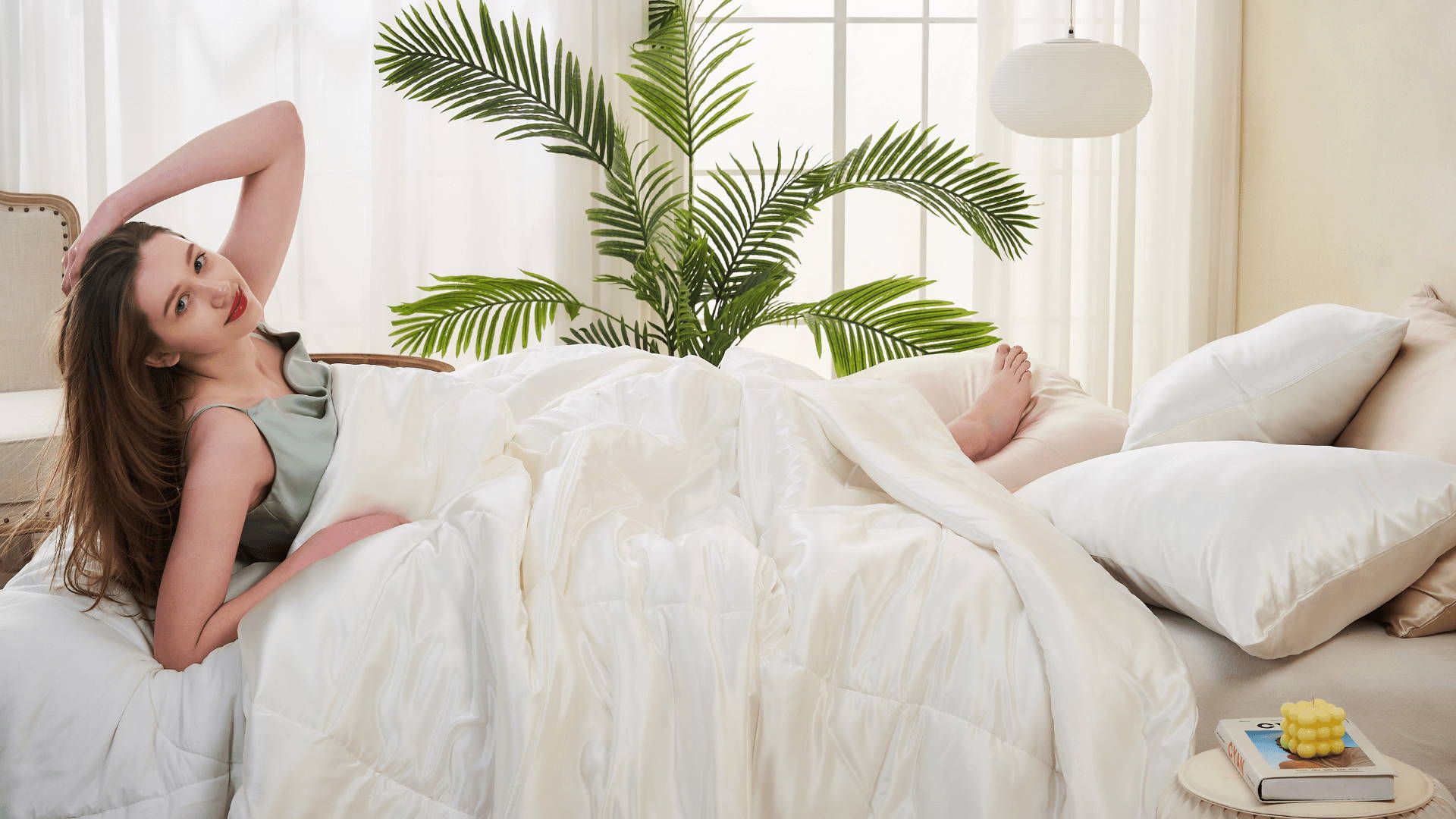
Before we compare, let’s clarify—because confusion begins at the definition. In American bedding vernacular, “quilt” and “comforter” are often used interchangeably—but they’re not synonyms. They’re distinct constructions with different origins, purposes, and performance profiles.
A quilt is traditionally a three-layer assembly: a top fabric, a middle insulating layer (batting), and a bottom backing—stitched together in a decorative or functional pattern (like channel, diamond, or grid quilting). Historically handmade and heirloom-grade, modern quilts prioritize breathability, lightness, and tactile softness over thermal density. Think of them as your bedding’s “second skin”—designed to drape, conform, and regulate—not compress or suffocate.
A comforter, by contrast, is typically a single-layer, heavily filled, baffle-box or stitched-through construction meant to provide substantial loft and insulation. Traditional comforters use down, down-alternative polyester, or wool fillings—materials that trap heat and require frequent professional cleaning. Many mass-market “comforters” are built for visual volume, not climate responsiveness—and that shows up in your morning skin, your frizzy hairline, and your 3 a.m. wake-up call from overheating.
Here’s what matters most for city professionals: It’s not the label—it’s the fiber, the fill, and the finish. A quilt made from synthetic microfiber will feel clammy and shed microplastics. A comforter made from OEKO-TEX® certified 23-momme mulberry silk? That’s a climate-adaptive, skin-repairing, anti-friction system—regardless of whether it’s called a quilt or a comforter on the tag.
Let’s move beyond dictionary definitions and into lived experience—the kind that shows up in your reflection, your energy levels, and your laundry basket.
Urban apartments are heat islands. Concrete retains warmth. Windows act like solar ovens. And traditional down or polyester comforters hold heat like a thermos—trapping body moisture, raising skin surface temperature, and disrupting REM cycles. Studies show even a 1°F increase in sleeping surface temperature can reduce deep sleep by up to 23% (Sleep Medicine Reviews, 2021).
Quilts—especially those built with natural, breathable materials—offer superior airflow. But not all quilts are created equal. A cotton quilt may breathe, but it lacks the smooth, low-friction surface needed to prevent overnight hair tugging or pillow creases on delicate facial skin. Enter Promeed’s Skin-like™ Silicone Quilt: engineered with a hypoallergenic silicone coating that mimics human skin’s pH and texture. Its ultra-lightweight, machine-washable construction delivers year-round thermal neutrality—cool enough for NYC July nights, yet warm enough for London’s damp autumn mornings—without synthetic bulk or chemical finishes.
Here’s something high-end beauty editors rarely mention: your bedding is your longest-lasting skincare product. You spend $120 on a serum—you sleep on a rough, high-thread-count cotton sateen sheet or a polyester comforter for eight hours. Every night, that surface drags across your face and hair follicles—causing micro-tears, inflammation, and accelerated collagen breakdown.
That’s why 64% of Promeed’s customers choose silk not for “luxury,” but for clinical results: reduced hair breakage, fewer sleep lines, calmer eczema flare-ups, and visibly smoother morning skin. Our 23mm 6A+ 100% Mulberry Silk Duvet Cover (yes—technically a duvet cover, but used as a lightweight comforter-quilt hybrid) features a dense 23-momme weight and tightly woven 6A-grade filaments that create an impossibly smooth, frictionless surface. Paired with our learn what 23-momme really means, it forms a complete anti-aging sleep ecosystem—one that aligns perfectly with the “Skinimalism” philosophy: minimal steps, maximum efficacy.

You filter your tap water. You use an air purifier. You wash your face twice daily. Yet your bedding remains one of the most polluted surfaces in your home—harboring dust mites, pollen, PM2.5 particles, and volatile organic compounds (VOCs) tracked in from sidewalks and subways.
Traditional comforters—with their dense fills and non-washable construction—are allergen magnets. Even “hypoallergenic” polyester alternatives degrade over time, shedding microfibers and losing efficacy after six months. Quilts made from untreated cotton or bamboo rayon may be soft, but they lack inherent antimicrobial properties.
Promeed’s Skin-like™ Silicone Quilt is inherently hypoallergenic: silicone resists dust mite colonization, mold, and bacterial growth. It’s also OEKO-TEX® Standard 100 certified—meaning every component has been tested for over 350 harmful substances, from formaldehyde to heavy metals. For urban professionals with sensitive skin, seasonal allergies, or postpartum hormonal shifts, this isn’t “nice to have.” It’s your nightly immune buffer.
Scroll through any major retailer’s “machine-washable comforter” section, and you’ll find dozens of polyester blends promising “no dry clean needed.” What they don’t tell you: after three washes, the fill clumps, the stitching puckers, and the surface develops static cling that attracts lint and pet hair like a magnet.
True ease-of-care means durability and performance retention. Our Skin-like™ Silicone Quilt is fully machine washable—cold gentle cycle, tumble dry low—without compromising its silky-smooth finish or structural integrity. No special detergents. No air-dry-only mandates. Just clean, consistent performance, wash after wash.
Compare that to mulberry silk: while silk requires slightly more mindful care (hand wash or delicate cycle, air dry flat), its 23-momme density and 6A-grade fiber length ensure extraordinary longevity. A well-cared-for Promeed silk duvet cover lasts 5–7 years—far outperforming fast-fashion bedding priced similarly but built to fail. That’s the Smart-Luxury Mindset: paying once for integrity, not repeatedly for replacement.
Your bedroom isn’t a showroom. It’s your decompression chamber. So your bedding shouldn’t scream “look at me”—it should whisper “breathe deeper.”
That’s why Promeed’s palette leans into quiet luxury: nude, soft grey, blush pink, and ivory—not neon, not monogrammed, not oversized branding. Our quilting patterns are subtle and functional (to lock filling in place), never ornamental. Even our silicone coating is matte-finish, not glossy—designed to absorb light, not reflect it—so your space feels restful, not reflective.
Whether you’re layering the Skin-like™ Quilt under a linen duvet cover for textural depth or using the 23mm silk set as a minimalist, single-layer comforter alternative, every piece serves your sanctuary—not your Instagram feed.
Forget “which is better.” Ask instead: Which solves my most urgent sleep problem right now?
This layered approach mirrors how dermatologists treat skin: cleanse + protect + nourish. Your bedding should do the same.
You’ve seen “momme” everywhere—on silk pillowcases, sheets, even scarves. But what does 23-momme actually mean? And why does Promeed insist on it—when cheaper brands tout “19-momme” or “22-momme” as “premium”?
Momme (pronounced “moh-may”) is a Japanese unit measuring silk weight per square meter. Think of it like thread count for cotton—but far more meaningful for silk. Higher momme = denser weave, greater durability, smoother surface, and superior thermal regulation.
19-momme silk is lightweight—ideal for scarves or summer pillowcases. But for full-body coverage (sheets, duvet covers, quilts), 23-momme is the proven threshold for optimal performance: thick enough to block friction and retain shape, yet light enough to breathe and drape naturally. Anything below 22-momme risks pilling, snags, and premature thinning. Anything above 25-momme becomes stiff, heavy, and less adaptable to body movement.
Promeed’s 23-momme standard isn’t arbitrary—it’s calibrated to the exact density needed for urban sleepers who demand both resilience and refinement. Every yard is third-generation 6A+ mulberry silk, sourced from pesticide-free sericulture farms and certified OEKO-TEX® Standard 100 Class I (the strictest tier—safe for infants).
And because we cut out the “brand tax,” you get hotel-grade 23-momme integrity—without the $495 price tag.
You didn’t build your career, curate your apartment, or cultivate your calm by settling. So why settle on bedding that compromises your skin, your hair, or your peace?
The quilt vs comforter debate ends not with a winner—but with clarity. Clarity that a quilt isn’t just “lighter,” and a comforter isn’t just “warmer.” They’re tools. And the right tool depends on your physiology, your environment, and your values.
For the modern city woman who measures success not just in promotions, but in rested eyes and smooth skin—that tool is intentional. It’s OEKO-TEX® certified. It’s 23-momme. It’s hypoallergenic, cooling, and quiet in its luxury.
Your urban oasis isn’t built in a day. It’s woven, one thoughtful layer at a time.
Material standards differ significantly. Traditional comforters often use polyester batting or down fill—neither of which is regulated for skin contact safety. Quilts vary widely: cotton quilts may meet basic textile labeling rules, but only OEKO-TEX® Standard 100-certified quilts (like Promeed’s Skin-like™ Silicone Quilt) guarantee absence of formaldehyde, heavy metals, and allergenic dyes. The FTC requires accurate fiber content labeling for all bedding sold in the U.S., but doesn’t mandate safety testing—making third-party certification essential for urban dwellers with sensitive skin.
Yes—many Promeed customers use the 23mm 6A+ 100% Mulberry Silk Duvet Cover as a lightweight, year-round comforter alternative. At 23-momme, it provides sufficient body and drape to replace heavier layers without overheating. Its 6A-grade filament length and tight weave deliver exceptional tensile strength: lab-tested to withstand 500+ gentle machine washes before measurable thinning. Unlike lower-momme silks, it resists pilling and maintains its smooth surface through repeated use—making it ideal for daily wear in high-stress urban environments.
Promeed readers are usually comparing comfort, material quality, care effort, and long-term value before choosing silk bedding. Use this guide as a practical decision path: match the fabric to your sleep priorities, then check whether the care routine fits your household.
For shoppers leaning toward mulberry silk, focus on smooth hand feel, momme weight, gentle washing, and daily friction against hair and skin. Those details keep the article grounded in Promeed’s silk bedding expertise without turning the comparison into a generic fabric overview.
If these criteria match what you need, use the next step below to compare materials, care details, and available options.
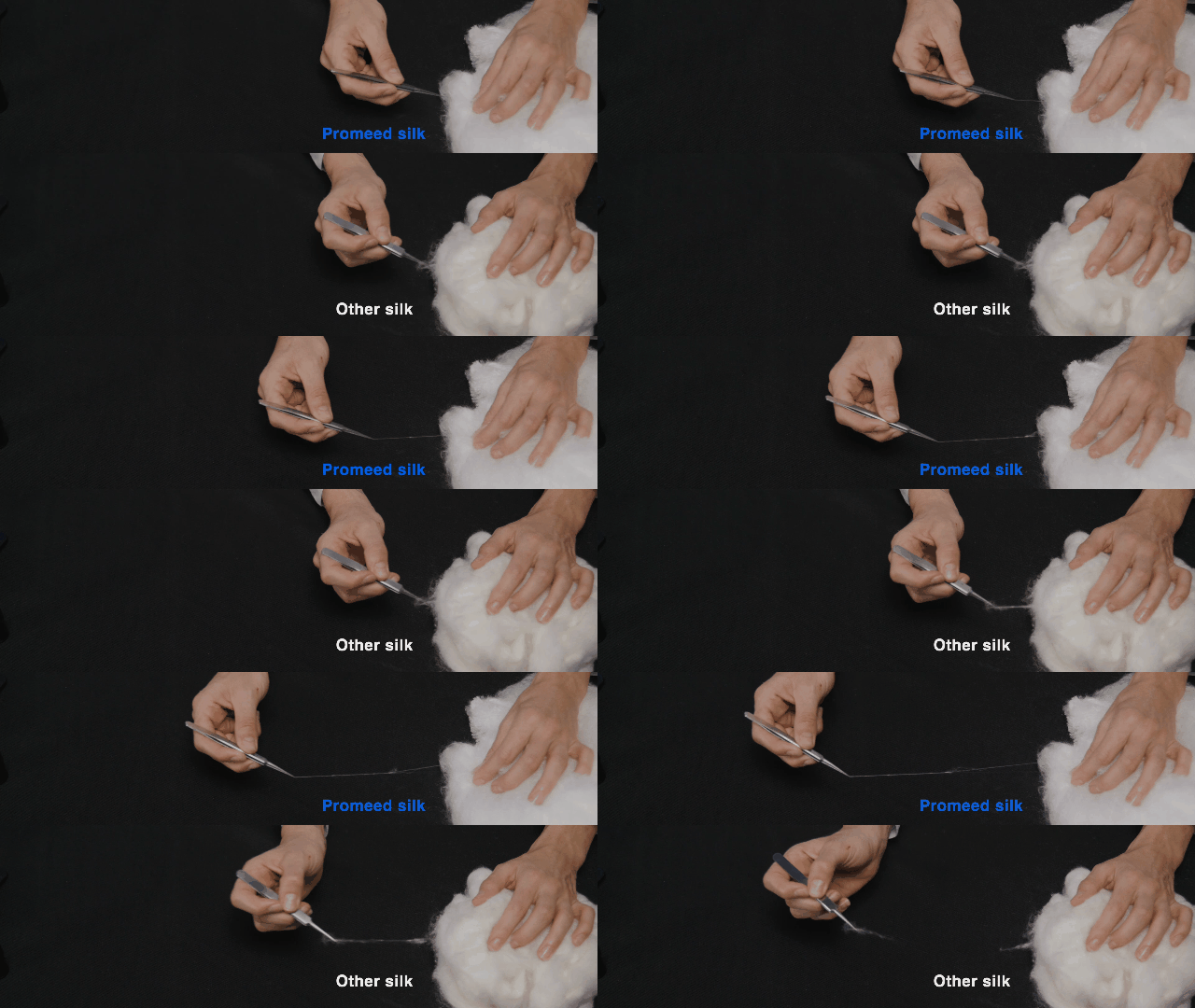
Cooling Comforters for Real Life: Urban Apartments, RVs & Menopause | Promeed Urban Oasis
When your 32nd-floor Shanghai apartment hits 84°F at midnight — no ducts, no AC — a cooling comforter isn’t luxury. It’s your thermal lifeline. Explore evidence-backed use cases for Promeed’s 23-mo...
閱讀更多
Melatonin-Free Sleep Aids: 23-Momme Silk & HerbalRX™ for Urban Professionals
Move beyond melatonin with clinically relevant, natural sleep support—HerbalRX™ bedding and 23-momme mulberry silk designed for urban professionals who demand purity, performance, and peace.
閱讀更多
留言
此網站已受到 hCaptcha 保護,且適用 hCaptcha 隱私政策以及服務條款。